
 العربية
 中文語言
中文語言
 हespañol
 русский
 Português
 Le français
 Deutsch
 Português

In the Mauritanian Digital Solutions Office (RCM) we develop artificial intelligence agents capable of performing real tasks within organizations, interacting with customers, employees, and various systems, and helping to automate processes that previously required repeated human intervention.
We do not treat the artificial intelligence agent as just a chatbot that answers questions, but as a smart digital assistant that can be equipped with the knowledge, tools, and permissions necessary to understand requests, take appropriate actions, and execute a series of tasks automatically.
What is an artificial intelligence agent?
An artificial intelligence agent is a software system that uses artificial intelligence models to understand and interact with information and instructions, and it can be linked to the organization's tools and systems to perform actual tasks.
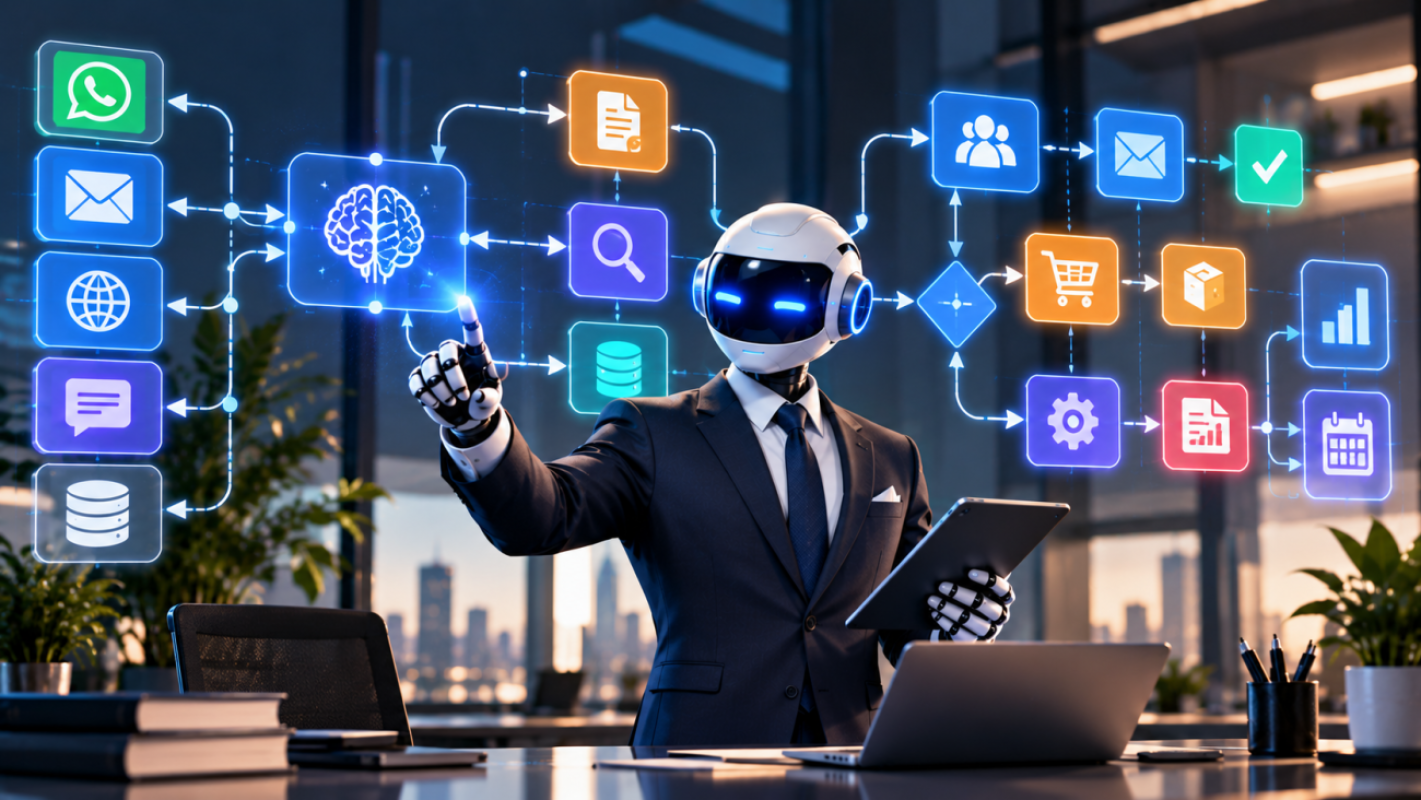
Instead of just answering the customer's question, the agent — according to the permissions granted to it — can search for customer data, check the status of a request, create a task, update a record, send a message, prepare a report, or run a process within another system.
Thus, artificial intelligence transitions from a mere conversation to a tool capable of assisting in executing work.
Agents for customer service
A smart agent can be built to handle customer inquiries through various channels such as the website, WhatsApp, and email, and other channels adopted by the organization.
It can be provided with information about services, products, policies, and frequently asked questions, and linked to the appropriate systems to obtain updated information when needed.
When a situation requires human intervention, the conversation or task can be transferred to the relevant employee while retaining the context of the request.
Agents for sales and follow-up
Artificial intelligence agents can assist sales teams at different stages of the customer lifecycle, such as receiving potential customers, understanding their needs, classifying opportunities, providing initial information, and following up according to established business rules.
A system can also be designed to include multiple agents, each specializing in a specific task such as searching for potential customers, communicating, following up, or assisting the sales manager in monitoring the progress of operations.
Agents for internal operations
The use of agents is not limited to dealing with customers.
Internal assistants can be built for employees and management to help search within the organization's information, prepare summaries and reports, follow up on tasks, organize information, and perform repetitive procedures.
The agent can be designed to operate according to a specific role and clear permissions, so it cannot access or perform operations outside the scope of the responsibilities granted to it.
Linking agents to the organization's systems
The value of the artificial intelligence agent increases when it becomes part of the organization's digital infrastructure.
We can link agents with ERP and CRM systems, websites and applications, databases, email, WhatsApp Business API, APIs, support systems, and automation platforms, and other tools.
This way, the agent can benefit from the available data and services to perform its tasks instead of functioning as a separate system.
Multi-agent systems
Some processes do not require a single agent, but rather a group of specialized agents working within a single workflow.
For example, an agent can be created for searching and gathering information, another for communication, an agent for follow-up, and another for analysis or overseeing the process.
The transfer of tasks and information between agents is organized according to Workflows and specific rules, allowing for the construction of more advanced processes while maintaining control at every stage.
Knowledge specific to your organization
The agent can be provided with approved resources within the organization such as documents, guides, frequently asked questions, product and service information, policies, and knowledge bases.
This helps it provide answers and actions more relevant to the context of the organization, rather than relying solely on the general knowledge of the artificial intelligence model.
Automation with human oversight
The goal of artificial intelligence agents is not to eliminate the role of employees, but to reduce repetitive tasks and help them focus on tasks that require expertise and human judgment.
Therefore, processes can be designed so that the agent operates automatically in appropriate tasks, while sensitive or important procedures require human review or approval before execution.
Agents designed according to the nature of work
We do not offer a one-size-fits-all model for all organizations.
We start by studying the process that the organization wishes to develop: who executes it? What information is required? What systems are used? And what procedures can the agent safely perform?
Then the agent, tools, integrations, and workflow are designed according to these requirements.
Development, testing, and continuous improvement
After building the agent, the core scenarios and how it interacts with information, tools, and permissions are tested, and then instructions, workflows, and integrations are improved based on usage results.
As the organization's needs evolve, new knowledge sources, tools, and channels can be added, or the agent's tasks can be expanded and linked to additional systems.
Turn artificial intelligence into a part of your team
In the Mauritanian Digital Solutions Office (RCM), we help organizations transition from using artificial intelligence as a separate tool to building smart agents connected to their operations, systems, and data.
Whether you need an agent for customer service, sales and follow-up, internal operations, or a multi-agent system to execute a comprehensive process, we work to build the solution according to your organization's needs and way of working.
Make artificial intelligence capable of helping to accomplish work, not just talking about it.