
 العربية
 中文語言
中文語言
 हespañol
 русский
 Português
 Le français
 Deutsch
 Português
ERP for Your Business: Easier Management, Clearer Insights, and Ready for Growth
As a business grows, so do the areas that need to be managed: sales, purchasing, inventory, accounting, customers, suppliers, employees, and branches.
At the beginning, Excel spreadsheets and a few separate applications may be enough. But as operations expand, a new problem begins to appear:
The information exists… but it is scattered across different places.
The sales team has its numbers, the warehouse has its own records, accounting works with another system, while management has to bring all of this information together just to understand the real situation of the business.
This is where an ERP system becomes valuable.
What Is ERP, Simply?
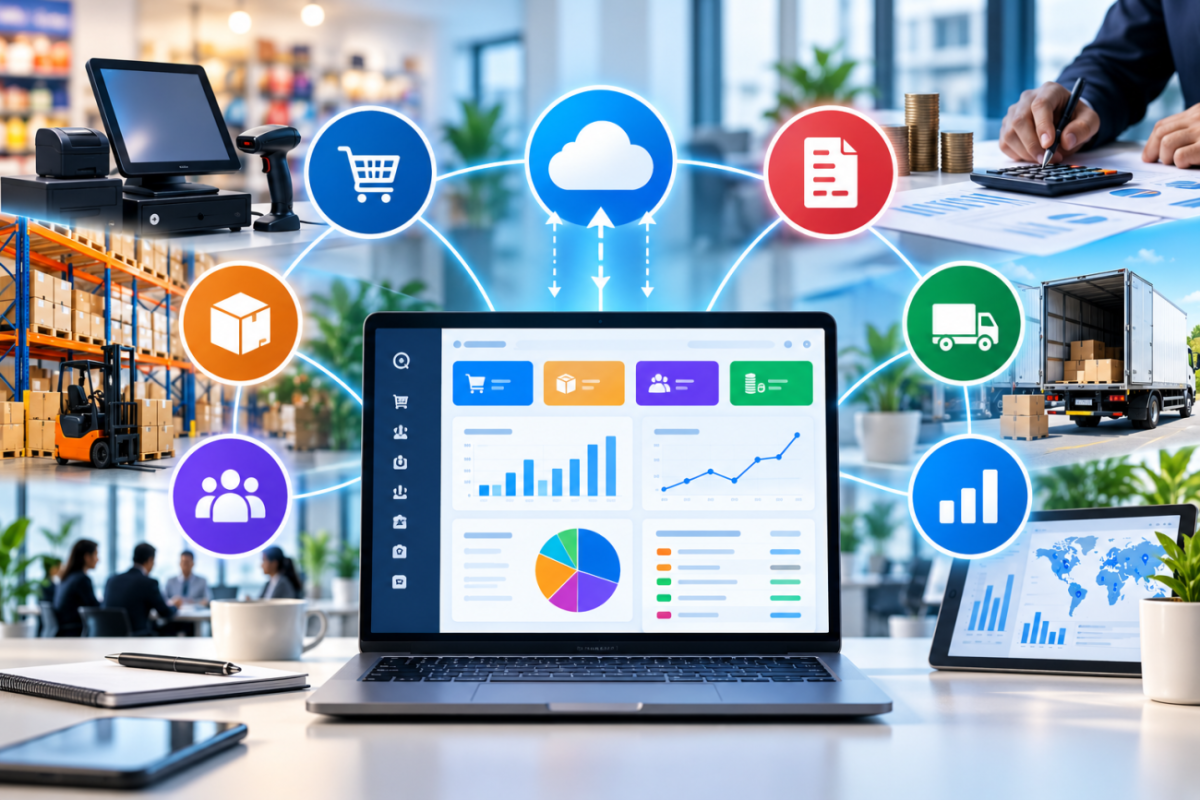
ERP is a system that helps you manage different departments and operations of your business from one place.
Instead of using one application for sales, another for inventory, and separate files for purchasing and accounting, these operations can be brought together within one integrated system.
The benefit is not only easier management. The data itself becomes connected across departments.
One Transaction Can Update Multiple Areas
Imagine that an employee records a sale.
Depending on how the system is configured, the inventory can be updated, the customer transaction recorded, the accounting impact reflected, and the relevant reports updated.
When new goods arrive, the purchase can be recorded, linked to the supplier, and the relevant inventory quantities and accounts can be updated.
Instead of entering the same information multiple times, every transaction becomes part of one organized workflow.
This is where a business begins to save time, reduce errors, and improve coordination between departments.
Management Becomes Clearer
Every manager needs answers to important questions:
How much did we sell today?
What is currently in stock?
Which products need to be reordered?
How much do customers owe us?
What do we owe our suppliers?
How is each branch performing?
When information is scattered across multiple files and applications, answering these questions becomes slower and more difficult.
With an integrated ERP system, data and reports become more organized, giving management a clearer view of business performance and better information for decision-making.
But What Happens If the System Goes Down?
This is one of the most important concerns for any organization that depends on a digital system for its daily operations.
If sales, inventory, accounting, and branches all depend on the system, slow performance or downtime at a critical moment can directly affect business operations.
This becomes even more important as the number of users, branches, and simultaneous transactions increases.
So when choosing an ERP system, it is not enough to ask:
What can the system do?
You should also ask:
Can the infrastructure behind it handle the demands of my business?
That Is Why We Focus on Both the System and the Server
At Mauritanian Digital Solutions Office (RCM), we do not treat ERP as software that is separate from the infrastructure running it.
We provide highly stable, high-performance, and scalable cloud servers and infrastructure, with resources configured according to the size of the project, number of users, type of operations, and expected workload.
As the business grows and usage increases, resources and infrastructure can be scaled to meet new requirements.
This means the system is not designed only for what your business needs today, but also with future growth in mind.
What About Your Business Data?
There are other concerns that are just as important as system performance.
What about sales data?
Accounting records?
Inventory?
Customer and supplier information?
This information is a fundamental part of your business. That is why permissions, security, backups, and access management should be considered from the beginning when designing the system.
The goal is not simply to run an ERP system, but to build an environment that the organization can rely on for its daily operations.
What If the Internet Connection Goes Down?
Not every organization operates under the same conditions.
Some businesses depend heavily on continuous connectivity, while critical operations—such as point-of-sale activities—may require additional continuity solutions.
Depending on the nature of the project, local operating solutions or appropriate continuity mechanisms for critical operations can be considered alongside the cloud system.
We do not choose a technology simply because it is popular. We choose the infrastructure that best fits the way the organization actually works.
A System That Grows With Your Business
Today, you may have one branch and a limited number of employees. Tomorrow, you may add more branches, users, and services.
Your system should not become an obstacle to that growth.
An ERP system can be designed to expand with your organization, allowing new modules and capabilities to be added when needed and integrated with solutions such as:
Point-of-sale systems, websites, mobile applications, CRM, e-commerce platforms, booking systems, APIs, automation, and AI agents.
Over time, the ERP system can become the central hub of your organization’s digital ecosystem.
The Right System Starts With Understanding the Business
There is no single ERP configuration that works equally well for every organization.
A retail store has different needs from a restaurant. A service company operates differently from a distribution business. A multi-branch organization has different requirements from a small business operating from a single location.
That is why implementing an ERP system should begin with understanding how the organization works:
How are sales handled?
How does purchasing work?
How is inventory managed?
Who needs access to each part of the system?
What reports does management need?
What are the organization’s plans for growth?
Once these questions are understood, the right system, customizations, and infrastructure can be determined.
With RCM, You Get More Than Just Software
At Mauritanian Digital Solutions Office (RCM), we build business management solutions around the way each organization actually operates.
We analyze requirements, implement and customize ERP and business management systems, configure cloud infrastructure, connect systems and services, and develop the necessary integrations and automation.
From sales, purchasing, inventory, accounting, and point of sale to branches, reporting, integrations, and artificial intelligence.
Our goal is not simply to add another piece of software to your organization.
Our goal is to bring your operations together into one stable, clear, and scalable system that grows with your business.
Comments
There is no data here up to now
Add New Comment